How to Rank in Google AI Overviews (2026 Guide)
How to rank in Google AI Overviews, explained by engineers who optimize for AI search. Learn what AI Overviews reward and how to get your content pulled in.
June 3, 2026 · 10 min read · By Nick Vadini
Google AI Overviews now sit at the very top of the results page for billions of searches, above the first blue link. Google said in 2025 that AI Overviews reach more than 1.5 billion users every month, which makes them the most-seen surface in search. If your content is not feeding those answers, you are below the fold on the queries that matter most. Learning how to rank in Google AI Overviews is the same discipline we run inside MintUp's AI search optimization service, and this post is the practical playbook for 2026.
AI Overviews are not a separate product you submit to. They are generated from Google's regular index, so the path to appearing in them runs through content and structure you already control. This guide covers what an AI Overview is, how Google decides what to pull in, and the exact steps to get your pages quoted. If you want the local-search angle specifically, our breakdown of how AI Overviews are changing local search goes deeper on Google Business Profile and map queries.
TL;DR: To rank in Google AI Overviews, answer one specific question per section in 2 to 3 self-contained sentences, earn a top-10 organic ranking for that query, add FAQ and Organization schema, use specific numbers and recent dates, and keep Google-Extended unblocked in robots.txt. AI Overviews mostly draw from pages that already rank well, so strong traditional SEO plus clean extractable passages is the winning combination.
What is a Google AI Overview?
A Google AI Overview is an AI-generated summary that appears at the top of Google search results for many queries, built by Gemini from content across the web and shown above the traditional list of links. It answers the question directly on the results page and links to a handful of source pages it used. Google launched AI Overviews in May 2024 and has expanded them across more query types since. For your business, the practical shift is simple: ranking a page is no longer enough, because the answer now appears before anyone scrolls to your link.
AI Overviews are part of the broader move toward answer engines, the same trend behind ChatGPT and Perplexity. Optimizing for all of them is called generative engine optimization, or GEO. Google AI Overviews are the highest-volume member of that group because they sit inside the search engine most people already use every day. Winning here reaches more buyers than any other AI surface.
How does Google choose what to put in an AI Overview?
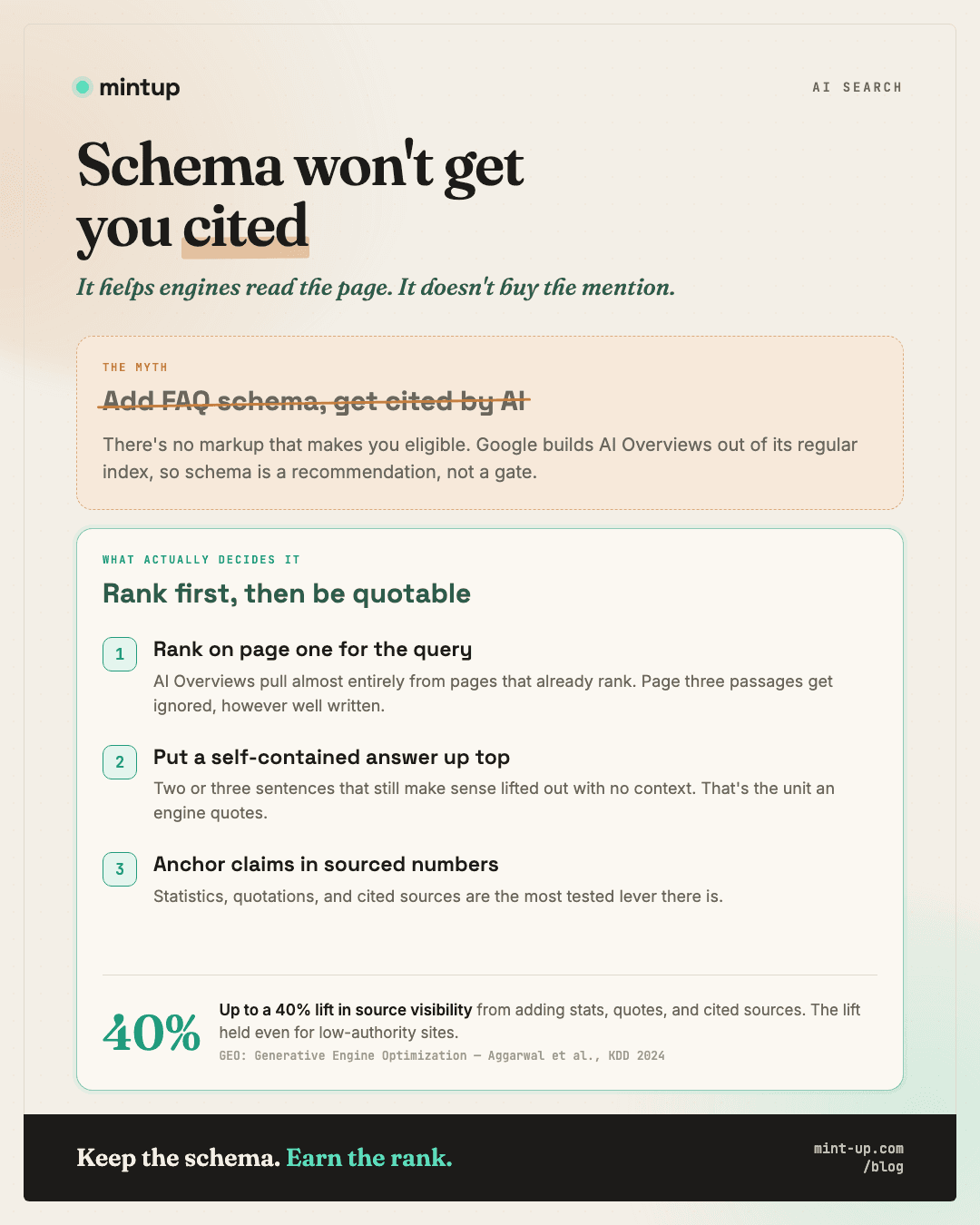
Google builds an AI Overview by running a search behind the scenes, gathering relevant pages from its index, and asking Gemini to synthesize an answer from them. A page becomes a cited source when it ranks well for the query and contains a clear passage that answers the question directly. In our experience, the pages that get pulled in almost always already rank on page one for the same search. AI Overviews rarely surface a source that traditional ranking buried, so organic strength is the entry ticket.
Once a page qualifies as a candidate, citability decides whether it actually gets used. Gemini favors passages that state a fact, definition, or step plainly, without hedging or padding. A page that answers the question in its first two sentences beats one that makes the model dig through three paragraphs of setup. This is why a focused, well-structured page can earn a citation even against larger competitors: the model is looking for the cleanest answer, not the biggest site.
Google also weighs trust and freshness heavily for AI Overviews, especially on topics that affect health, finances, or major decisions. Clear authorship, an identifiable organization, consistent entity signals, and recent update dates all raise the odds your page is chosen. When sources conflict or look thin, Google tends to fall back to established authority sites, so the trust signals you build directly affect whether you make the answer.
Google AI Overviews vs traditional search results: what is different?
The core difference is what wins. Traditional search rewards the page that ranks highest for clicks. AI Overviews reward the passage that answers the question best, then credit the page it came from. The two share fundamentals like quality content and clean structure, but they diverge on format, payoff, and how you measure success. Here is the side-by-side.
- Goal: traditional search wants you ranked in the top 10 links. AI Overviews want a passage from your page quoted in the summary at the top.
- What gets rewarded: traditional search weighs relevance, backlinks, and authority. AI Overviews weigh those plus passage clarity and how directly you answer the exact question.
- Content format: long comprehensive pages can win in traditional search. AI Overviews favor self-contained passages the model can lift cleanly.
- Payoff: traditional search sends a click. An AI Overview sends a brand citation plus a smaller share of clicks, so visibility itself is part of the value.
- Position: the top organic result still sits below the AI Overview, so the summary, not position one, is now the real top of the page.
- Measurement: traditional rankings are easy to track. AI Overview presence requires running the query yourself and checking whether you are quoted or linked.
Google generates AI Overviews from its standard index, and Google has said publishers do not need a special tag to be eligible. Blocking Google-Extended limits use of your content for some Gemini training, but your pages can still appear as cited sources in AI Overviews as long as Googlebot can crawl them. Confirm Googlebot is not blocked before anything else.
How do you rank in Google AI Overviews?
You rank in Google AI Overviews by earning a strong organic position for the query and then making your answer the easiest one to extract. There is no submission form and no separate algorithm to game. You strengthen the same signals Google has always rewarded, then format your content so Gemini can lift a clean, factual passage. Here are the seven steps we run for clients, in priority order.
- Earn a page-one ranking first. AI Overviews pull almost exclusively from pages that already rank well. Solid traditional SEO, relevant content, internal links, and backlinks remain the entry ticket.
- Answer the exact question up front. For each target query, put a 2 to 3 sentence answer at the top of the relevant section that stands alone without context. Front-load the answer, then expand below.
- Match the query phrasing in a heading. Use the real question as an H2 or H3 so Google can map your passage to the search. Question-format headings get pulled into AI Overviews and featured snippets.
- Add FAQ and Organization schema. FAQ schema hands Google pre-formatted question-answer pairs. Organization schema confirms your name, services, and location as one trusted entity.
- Use specific numbers and named sources. Replace "we save clients time" with "clients save an average of 20 hours per week," and attribute stats to a named source. Specific, sourced claims get quoted far more often.
- Show freshness and authorship. Display a visible publish or update date, a named author, and recent examples. Google leans on fresh, clearly attributed content for AI Overviews.
- Build topical depth. A cluster of related, interlinked pages signals real expertise on a subject, which raises your odds of being the trusted source Google reaches for repeatedly.
Steps one through three carry most of the weight. If you already rank on page one, rewriting your opening passage and adding a question-format heading can be enough to get quoted within a crawl cycle or two. Steps four through seven compound over time and are what turn a single appearance into a page Google trusts across a whole topic. The work is unglamorous, but it is repeatable, and it is the same loop we teach inside how to show up in ChatGPT, Perplexity, and AI search.
What content does Google pull into AI Overviews most?
Google pulls in content that reads like a direct answer to a specific question. Definitions, step-by-step instructions, comparisons, and data-backed statements get used the most because they map cleanly onto how people search. A page that states the answer in its first paragraph, under a heading that mirrors the query, is far more likely to be quoted than one that buries the point. The format of your content should match the shape of the answer Google wants to show.
Certain query types lean on AI Overviews more than others. Informational and how-to searches almost always trigger one, while purely navigational or transactional searches often do not. That means your highest-value targets are the questions customers ask while researching, not the ones they type when they already know your brand. Mapping your content to those research-stage questions is the same instinct behind getting AI to recommend your business across every engine.
How MintUp approaches AI Overview optimization
When we run AI Overview optimization for a client at MintUp, we start with a query audit. We list the 20 to 30 research questions a client's customers actually search, run each one, and record whether an AI Overview appears, whether the client is cited, and who is cited instead. That baseline shows which queries already trigger an Overview and which of those are winnable. We have learned that the winnable ones are usually specific, lower-competition questions, not broad head terms owned by national publishers.
From there the work is methodical. We confirm the target page ranks on page one, rewrite its opening passage to answer the query head-on, align a heading to the exact question, and add the missing schema. One lesson we keep relearning is that ranking has to come first. We have watched perfectly written passages get ignored simply because the page sat on page three, and watched the same passage get quoted within weeks once the page climbed into the top results. AI Overview wins follow organic wins, not the other way around.
We run AI search audits for businesses in Cleveland and nationwide. The audit checks your visibility across Google AI Overviews, ChatGPT, and Perplexity, shows who is cited instead of you, and hands you a prioritized fix list. Most owners are surprised by how often a competitor is quoted on questions they should own.
Get your AI visibility auditWhat you can do this week
You do not need a site overhaul to start. Here is a short action plan you can finish in a few hours. If you want to understand the competitive stakes first, your competitors are already showing up in AI search, and the gap widens every quarter you wait.
- Search 10 questions your customers would ask, including "best [your service] in [your city]." Note which ones trigger an AI Overview and whether you are cited.
- For each query that triggers an Overview, check where your page ranks organically. If it is not on page one, that is the first thing to fix.
- Pick your five most important pages and rewrite the first paragraph of each to answer its core question in 2 to 3 self-contained sentences.
- Add a question-format heading that matches the exact search, plus FAQ schema with 3 to 5 real customer questions and clear 40 to 80 word answers.
- Replace three vague claims with specific, sourced numbers, and add or update a visible date on each page.
Run the same searches again in three to four weeks. Google re-crawls and regenerates AI Overviews regularly, so you will often see movement before a full ranking shift would show up. That feedback loop makes AI Overviews a fast place to learn what Google rewards, and the same passages tend to earn citations in Perplexity and ChatGPT too.
Frequently asked questions
How is ranking in AI Overviews different from regular SEO?
Regular SEO optimizes your page to rank in Google's list of blue links. Ranking in AI Overviews means getting a passage from your page quoted in the AI summary above those links. The two overlap heavily, since AI Overviews mostly draw from pages that already rank on page one. The added work is formatting a clear, self-contained answer that Gemini can lift, and matching it to the exact question being searched.
Do I need a special tag or submission to appear in AI Overviews?
No. Google generates AI Overviews from its standard search index, so there is no form to submit and no special markup required for eligibility. As long as Googlebot can crawl your page and you rank well for the query, you can be cited. Schema markup and clean structure help Google understand and extract your content, but they are recommendations, not a gate for appearing.
Why does my competitor show up in AI Overviews and I do not?
Usually because their page ranks higher organically for that query and states the answer more directly. AI Overviews pull from top-ranking pages, then favor the clearest passage. If a competitor is cited, check where each of you ranks for the search, then compare how plainly each page answers the question in its opening lines. Closing both gaps is how you take the spot.
Do AI Overviews hurt my website traffic?
They can reduce clicks on informational queries, since the answer appears on the results page. But being cited in the Overview keeps your brand visible at the very top and still earns clicks from people who want the full detail. The bigger risk is being left out entirely while a competitor is quoted. Optimizing to be the cited source protects your visibility as search behavior shifts.
How long does it take to appear in a Google AI Overview?
Faster than a full ranking change if your page already ranks on page one. Google re-crawls and regenerates AI Overviews frequently, so a rewritten passage or new schema can surface within a few weeks. If the page does not yet rank well, the timeline depends on traditional SEO, which usually takes longer. The fastest wins come from pages that already rank but answer the question poorly.

Nick Vadini
CTO at MintUp
Nick is the full-stack engineer who architects and ships MintUp's builds out of Brunswick, Ohio, from infrastructure to frontend polish across React, React Native, Supabase, Stripe, and AI integrations. He has spent years building the AI systems, custom software, and automations that let Northeast Ohio businesses run leaner.
More about Nick VadiniRelated MintUp services
- AI search optimizationShow up when customers ask ChatGPT, Perplexity, Grok, and Google AI for recommendations.
- Custom software developmentApps, dashboards, portals, and internal tools built around the way your business works.
- AI agentsAgents that answer questions, qualify leads, and handle the repetitive work for your team.
- The Second Brain workshopA working session to find where AI and automation create the most leverage for your business.