AI for Business
AI Agents for Business: A Practical 2026 Guide
What can AI agents do for your business? A practical 2026 guide from a team that builds them: real use cases, what they cost, and how to launch your first agent.
June 13, 2026 · 11 min read · By Nick Vadini
An AI agent for business is software that uses AI to complete a multi-step task on its own: it reads your data, decides what to do, takes the action across your tools, and asks for a human only when it should. That is the difference between an agent and a chatbot. A chatbot answers a question. An agent does the work. The businesses getting real value from AI in 2026 are the ones putting agents on the repetitive, expensive workflows that used to eat staff hours.
We build these systems at MintUp, where most of our work is shipping AI agents that handle live operational tasks for real companies. This guide is the practical version: what AI agents actually do for a business, what they cost, where they go wrong, and how to deploy your first one. If you want the deeper explanation of the technology itself, start with our breakdown of what agentic AI is, then come back here for how to put it to work.
What are AI agents for business?
AI agents for business are systems that pursue a goal across several steps without a human driving each one. You give the agent an objective, such as qualify this lead or reconcile these invoices, and it plans the steps, pulls the data it needs, uses your tools to act, and reports back. It runs inside your real workflow, not a sandbox. That autonomy, paired with access to your systems, is what separates an agent from a one-shot AI tool.
The shift is not hype. Gartner predicts that by 2028, 33 percent of enterprise software applications will include agentic AI, up from less than 1 percent in 2024, and that 15 percent of day-to-day work decisions will be made autonomously by agents. The point for a business owner is simple. The category is moving from demo to default, and the early movers are wiring agents into the workflows their competitors still run by hand.
How are AI agents different from chatbots and automation?
The difference is decision-making. A chatbot responds to one prompt at a time. Traditional automation follows a fixed script and breaks the moment reality does not match the rule. An AI agent sits in the middle of those two: it handles many steps like automation, but it adapts to messy input and judgment calls like a person would. That adaptability is why agents work on tasks rigid automation never could.
- Chatbot: answers a single question or request, then waits. Best for FAQs and quick lookups. No memory of the larger goal, no action across your systems.
- Rule-based automation: runs a fixed if-this-then-that script fast and cheaply. Best for clean, predictable steps. Breaks on exceptions and edge cases it was not programmed for.
- AI agent: pursues a multi-step goal, reads context, decides the next step, and acts across your tools. Best for workflows full of judgment and exceptions. Routes the hard cases to a human.
If you are weighing a conversational tool against something that can act, our deeper comparison of AI agents versus chatbots breaks down when each one is the right call. Most businesses end up with both: a chatbot at the front door for quick answers, and agents working behind it on the operational load.
What can AI agents do for your business?
AI agents do the repetitive, multi-step work that sits between your software and eats staff time. The strongest use cases share a pattern: high volume, clear rules most of the time, and a few exceptions that need judgment. That is exactly the shape of work agents handle well and humans find tedious. Here are the agent jobs we see deliver the fastest return.
- Lead qualification and follow-up: an agent reads inbound inquiries, scores them, drafts a tailored reply, and books the meeting, so no lead waits hours for a response.
- Invoice and document processing: it extracts data from invoices, receipts, and contracts, checks it against your records, and flags only the mismatches for a person.
- Customer support triage: it reads a ticket, answers the routine ones instantly, gathers context on the hard ones, and routes them to the right human with a summary attached.
- Operations and data entry: it moves information between your CRM, accounting tool, and project software so your team stops re-keying the same data into five systems.
- Research and reporting: it pulls numbers from your tools on a schedule, assembles the weekly report, and surfaces what changed instead of making someone build it by hand.
These are not the only options; they are the ones with the cleanest payback. For a wider list of where small and mid-sized teams start, see our roundup of AI use cases for small business. The right first agent for you is whichever of these costs your team the most hours today.
Not sure which workflow to hand to an agent first? We help businesses map their operations and rank tasks by return before any code is written. No pitch, just a clear look at where an agent would save you the most time.
Find Your Highest-ROI AgentWhat does a real AI agent look like in practice?
A real AI agent is connected, narrow, and measured. Connected means it has secure access to the tools where the work lives. Narrow means it owns one workflow well rather than promising to run your whole company. Measured means you set a target before launch and track it after. The agents that fail are the ones built broad and vague; the ones that win do a single job and prove it in numbers.
One client came to us with a 45-minute manual process that ran dozens of times a day. We built an agent that handled the routine path end to end and escalated the rare exceptions to a person. It cut the workflow to under 8 minutes, an 82 percent reduction, and that single result funded a department-wide platform. In another build, an agent owned sales follow-up and reclaimed about 20 hours a week for the team. The pattern repeats: pick the right workflow, connect the agent to the real tools, and the hours come back.
How much do AI agents cost for a business?
AI agents for business range from under $500 a month for a simple agent built on existing platforms to $15,000 to $60,000 for a custom agent wired across several of your tools. A single, well-scoped workflow usually lands in the lower-to-middle of that range. The number that matters more is payback: an agent that saves 15 hours a week at $40 an hour returns over $30,000 a year, so a well-chosen build often pays for itself within six to twelve months.
Two costs founders underestimate sit on either side of the build. First, the data and integration work: connecting the agent to your CRM, inbox, and records cleanly is where real early effort goes, and it overlaps heavily with the kind of systems integration any agent depends on. Second, ongoing upkeep: an agent needs monitoring and tuning as your data and edge cases shift. For a fuller breakdown of build economics, see what custom software costs. Treat an agent as a living system with a maintenance line, not a one-time purchase.
AI agents are only as good as the context they can reach. The Second Brain Workshop is a live two-hour session where we build your business's memory system with Claude, turning the calls, documents, and decisions scattered across your tools into context an agent can actually use.
See the Second Brain WorkshopHow do you deploy your first AI agent?
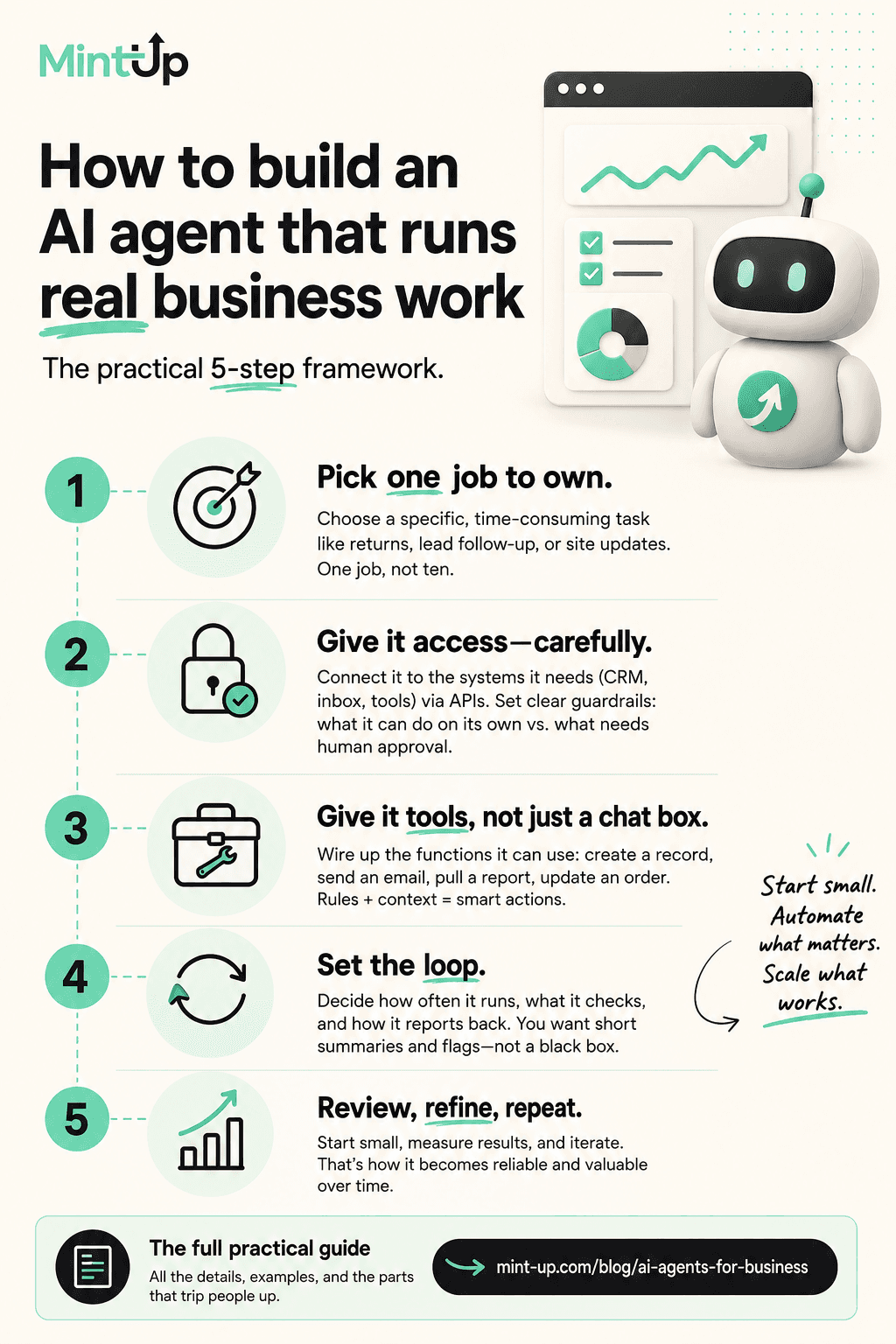
You deploy your first AI agent by starting with one workflow, setting a measurable target, and running the agent alongside the manual process before you trust it alone. The sequence protects you. Most agent projects miss not because the AI is weak, but because the team skipped straight to building before defining the problem. These five steps keep a first deployment focused.
- Pick one high-cost workflow. Choose something repetitive, rule-heavy, and expensive in hours or errors. Lead follow-up, invoice processing, and support triage are proven starting points.
- Set a measurable target. Define success up front: cut processing time from 45 minutes to under 10, or respond to every lead within 5 minutes. A vague goal cannot be proven.
- Connect the data and tools. An agent acts through your systems, so give it secure access to the CRM, inbox, or records it needs, and clean up the data it will read.
- Run a supervised pilot. Put the agent on a slice of real work for 30 to 90 days while a human reviews its output, so you catch edge cases before they reach a customer.
- Measure, then expand. Compare the result to your target, put the savings in dollars, and use that proof to fund the next agent, one workflow at a time.
Notice that building the agent is not step one. By the time you choose a tool or a partner, you already know the workflow, the target, and the data. For the full version of this rollout playbook across any AI project, see our guide to implementing AI in your business.
When do you not need an AI agent?
You do not need an AI agent when the task is simple, rare, or fully predictable. If a job runs cleanly every time with no exceptions, plain automation is cheaper and more reliable. If you just need quick answers to common questions, a chatbot is enough. If a workflow happens twice a month, the build cost will outrun the savings. An agent earns its keep on high-volume work full of small judgment calls, not on everything.
We tell prospects this directly, even though we build agents for a living. The fastest way to sour a team on AI is to point an agent at the wrong problem and watch it underdeliver. Honest scoping is part of the work. Sometimes the right answer is a simple integration or a chatbot, and saying so early is how you avoid spending real money on a system that was never the right fit.
Ready to put an AI agent to work on a real workflow? At MintUp, we help businesses pick the right first agent, build it, connect it to your tools, and prove the return, with an honest take on whether an agent is even the right call. If you want a partner who has shipped these before, let's talk.
Book a Free Discovery CallFrequently Asked Questions
What is an AI agent in business terms?
An AI agent is software that uses AI to complete a multi-step task on its own. You give it a goal, and it reads your data, decides the next step, acts across your tools, and escalates to a human when needed. Unlike a chatbot that only answers questions, an agent does the work: qualifying leads, processing invoices, or triaging support tickets inside your real systems.
What is the difference between an AI agent and a chatbot?
A chatbot responds to one prompt at a time and waits for the next. An AI agent pursues a multi-step goal: it plans, pulls data, takes actions across your tools, and adapts when the input is messy. Chatbots are best for quick answers and FAQs. Agents are best for operational workflows that used to require a person to move work between systems.
How much does an AI agent cost for a small business?
A simple agent built on existing platforms can run under $500 a month. A custom agent wired across several of your tools typically costs $15,000 to $60,000 to build, plus ongoing upkeep. The better measure is payback: an agent that saves 15 hours a week can return over $30,000 a year in labor, so a well-scoped build often pays for itself within six to twelve months.
What can AI agents actually do for a business?
AI agents handle repetitive, multi-step work between your software. Common jobs include qualifying and following up on leads, processing invoices and documents, triaging support tickets, moving data between your CRM and accounting tools, and assembling recurring reports. The best candidates are high-volume workflows with clear rules most of the time and a few exceptions that need judgment, which agents route to a human.
How do I get started with AI agents for my business?
Start with one high-cost workflow, set a measurable target, and run the agent alongside your manual process before trusting it alone. Pick something repetitive and expensive in hours, such as lead follow-up or invoice processing. Connect the agent to the tools where the work lives, pilot it on real work for 30 to 90 days, then measure the result and use the proof to fund the next agent.
Related MintUp Services
Ready to talk about your project?
Book a free discovery call. We'll dig into your goals and show you exactly how we can help.
Book a Discovery Call
Nick Vadini
CTO at MintUp
Nick is the full-stack engineer who architects and ships MintUp's builds out of Brunswick, Ohio, from infrastructure to frontend polish across React, React Native, Supabase, Stripe, and AI integrations. He has spent years building the AI systems, custom software, and automations that let Northeast Ohio businesses run leaner.
More about Nick VadiniRelated Articles
AI for Business
What Is Agentic AI? The Complete Guide for Business Owners
Agentic AI is artificial intelligence that can perceive, reason, decide, and act on its own. Learn what it means for your business, how it differs from chatbots, and where to start.
AI for Business
AI Agents vs. Chatbots: What's Actually Different
AI agents and chatbots are not the same thing. Chatbots answer questions. AI agents take action, make decisions, and complete multi-step workflows autonomously. Here's what actually separates them and when each makes sense for your business.
AI for Business
AI Use Cases for Small Business: 7 Real Examples
Practical AI use cases for small business, with real examples, typical ROI, and how to pick your first one. From a team that builds these systems every week.